A photo book brings your best images together in a printed book. But what exactly is a photo book, and how does it differ from an ordinary book or a print? Here you can read about its characteristics, its uses and what to watch out for when you have one made.
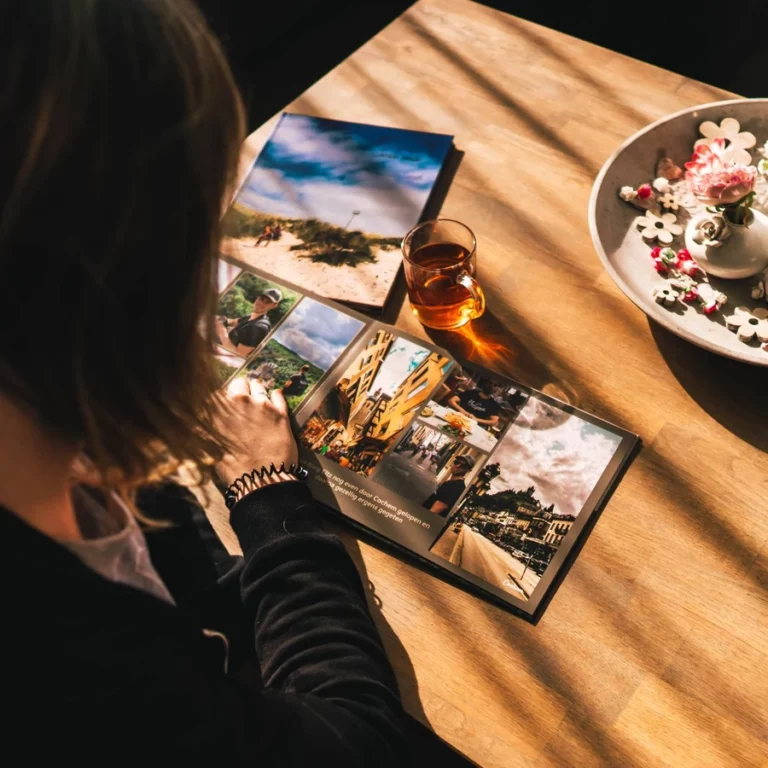
Characteristics of a photo book
Photo books are printed on heavier, often coated paper so that colours come across deep and saturated. A photo book is at its best as a hardcover with a sturdy, sewn spine, for a luxurious and durable look.
What do you use a photo book for?
- Wedding albums and other milestones
- Family history and memorial books
- Portfolios for photographers and designers
- Coffee-table books with visual stories
- Travel journals and year in review
What should you watch out for with a photo book?
Supply your photos in high resolution (at least 300 dpi at actual size) and in the right colour space. Choose a paper type and finish that suits the mood: matt for a calm, timeless look, gloss for extra contrast and depth. We are happy to think along with you about format, paper and binding.
Making your own photo book
Now that you know what a photo book is, you can put one together yourself. Pick your finest photos, arrange them into a story and keep the layout calm, because white space lets images breathe. Because we print from a single copy, you can assess a sample first before ordering more. For tips on colour reproduction on paper, turn to the International Color Consortium.
The structure of your photo book
A good photo book is a selection, not an archive. For every occasion pick the two or three images that carry the story and leave the rest out; a book of forty strong photos is better than a book of two hundred of which half look alike. Work in a fixed order, usually chronological, and let the spread — two pages side by side — be your starting point rather than the single page.
Dare to leave white. One photo with space around it draws more attention than six photos in a grid. Alternate between full-page images and smaller ones, and do not put every photo in the same place: that makes a book monotonous to leaf through.
Technical points of attention
- Resolution. At least 300 dpi at the size the photo will appear in the book, so calculate at actual size and not on pixel count alone.
- Bleed. Photos that run to the edge must continue 3 mm beyond the final format.
- The fold. Do not place faces or the horizon exactly in the middle of a spread; with a glued spine a few millimetres disappear there.
- Colour. Convert your images to CMYK and you will see in advance what happens to bright shades.
Unsure about paper or binding? Order a single copy first. With a photo book in particular that is the cheapest way to find out whether your choice works. You can read more about paper in our article on paper for photo books.
Frequently asked questions about photo books
What exactly is a photo book?
A bound book in which photos take centre stage, printed on high-quality photo paper with a considered layout, unlike loose prints or a text book.
What is the difference from loose photo prints?
In a photo book the images sit in a bound whole with a design that turns them into a story, on heavier paper than loose prints.
What resolution do my photos need?
At least 300 dpi at actual size, so that the photos print sharply and do not turn grainy.
How many photos fit in a photo book?
That depends on your layout. With one to three photos per spread, a 60-page book comes to roughly 40 to 90 images. Cramming in more is possible, but it costs you calm.
Hardcover or softcover for a photo book?
For a photo book you keep or give away, hardcover is usual: it protects better and looks like a real edition. Softcover works fine for a lighter, more informal book or a larger print run.