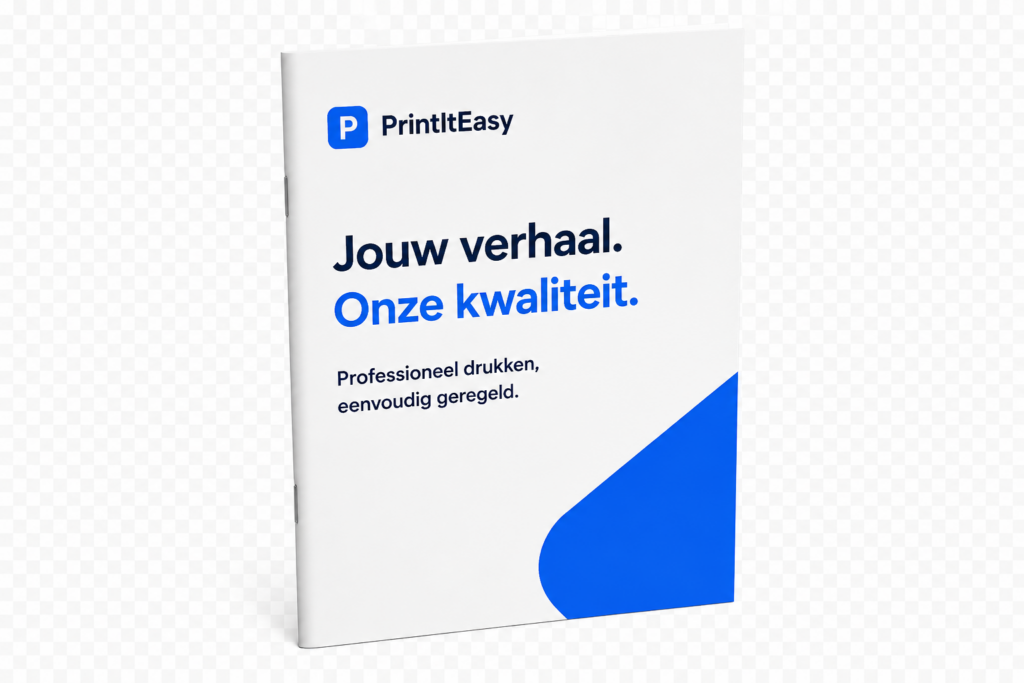
Booklet printing at PrintItEasy starts at one copy. Want to print a saddle-stitched booklet in professional quality? At Printiteasy you create crisp, colourful saddle-stitched booklets for series, customer magazines or one-off projects. Configure size, paper and binding online and calculate your price instantly, from a small print run to thousands of copies.
What is a saddle-stitched booklet suitable for?
Saddle-stitched booklets are ideal for customer and member magazines, periodicals, brochures, lookbooks, programme booklets and relationship magazines. Wherever you want to combine image and text attractively in a polished, flick-through format.
Options and specifications
- Sizes: standard A4 and other commonly used booklet sizes.
- Paper: coated matt (silk) or gloss, for sharp text and vivid images.
- Binding: saddle-stitched (staples in the spine) for thinner editions, or perfect bound for thicker booklets.
- Print run: from a small series to large, periodic print runs.
- Finishing: options for a professional, high-quality look.
Why print your saddle-stitched booklet at Printiteasy
With in-house production you keep control over quality and deliver on fixed, reliable timelines, handy for periodicals. You see the price instantly, get automatic file checking and order exactly the print run you need, without hassle.
Booklet printing: page count, paper and finish
Booklet printing is bound by one rule that catches most people out: the page count of a saddle-stitched booklet is always a multiple of four. Each sheet is folded once and produces four pages, so a booklet can run to 8, 12, 16 or 24 pages, but never 10 or 18. If your design lands on an odd number, the usual solutions are a blank end page, a colophon, or a page of notes. Plan for it in the layout rather than discovering it at the proof stage.
The second constraint is thickness. Saddle stitching works comfortably up to roughly forty to forty-eight pages, depending on the paper. Beyond that the inner pages start to push outwards, the spine will not lie flat, and the trim shaves progressively more off the inner margins. That effect is called creep, and it is the reason we shift the inner pages inwards a fraction during imposition. If your project runs longer, a different binding such as perfect binding is the better answer; our overview of comparing bindings sets the options side by side.
Preparing files for booklet printing
Supply your pages as single pages in reading order, not as spreads, and let us do the imposition. Add three millimetres of bleed on every outside edge and keep text at least five millimetres clear of the trim, because a folded and stitched booklet moves slightly more than a flat sheet. The checks in supplying files apply here as well, and exporting to a PDF/X profile as described by the PDF Association keeps fonts and colour behaviour predictable on press.
For paper, a 135 gsm silk or matt coated stock is the standard interior for a magazine-style booklet, while 90 to 120 gsm uncoated suits text-heavy work such as a programme or a report. A slightly heavier cover, typically 200 to 250 gsm, gives the booklet body without making it hard to fold. If you want to compare surfaces first, read coated or uncoated paper. The general principle of the technique is also described on Wikipedia.
Ready to see what your booklet costs? Calculate the price for your page count and print run, or start from a cover template if you still have to design the outside.
Frequently asked questions
Saddle-stitch or perfect binding, which should I choose?
Saddle-stitching (staples) is ideal for thinner booklets; with more pages, a glued spine gives a sturdier, higher-quality result. While configuring you’ll see what fits your extent.
Which paper should I choose for my booklet?
Silk (matt coated) reads calmly and looks polished; gloss makes images stand out more. Both give a professional result.
Can I have a periodic print run printed?
Yes, thanks to in-house production and fixed delivery times, recurring print runs are easy to plan.