With a photo book the result stands or falls with the paper. The right paper for a photo book makes the difference between dull snapshots and lively, sharp images. Here you can read which paper type and which weight suit your photo book best.
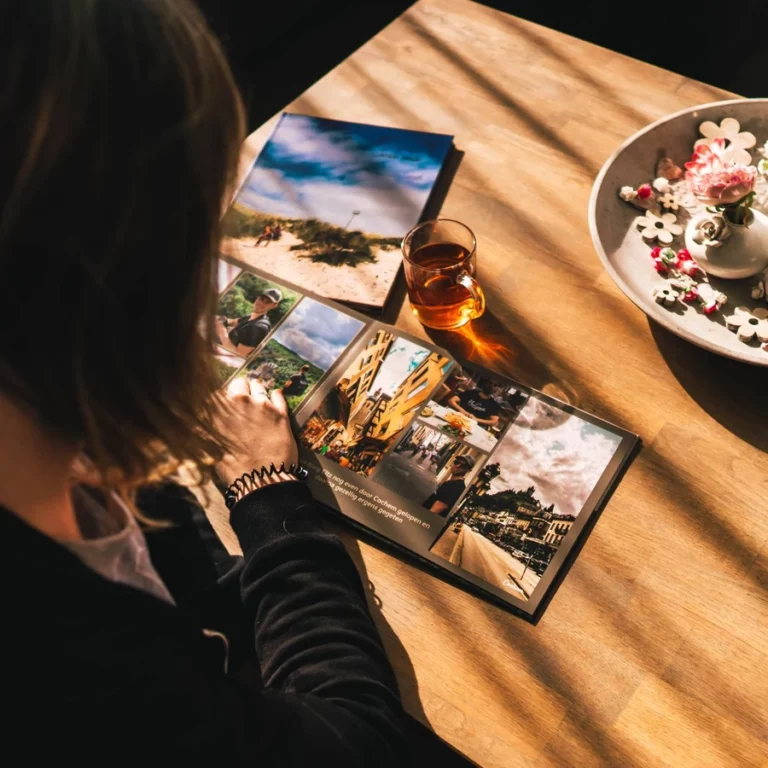
Coated paper for saturated colours
For photo books you almost always choose coated paper. The coating means ink penetrates less, so colours stay saturated and sharp. You choose between matt, silk and gloss.
Matt, silk or gloss?
- Matt: calm and timeless, no reflections, pleasant for viewing in bright light.
- Silk: the golden mean, slightly glossy with deep colours.
- Gloss: maximum contrast and depth, but also reflections and fingerprints.
Paper weight
For a luxurious photo book you choose 150 to 200 gsm, so that pages feel firm and do not show through. We are happy to advise you on the best paper choice and can show you a sample if you like.
Paper for a photo book and the impression it gives
The paper choice also sets the mood. Gloss paper suits a dynamic travel photo book full of bright colours, while matt or silk works better for an understated wedding album or an artistic photo book. So there is no best paper for a photo book: it depends on your photos and on the impression you are after.
In doubt? Request a proof, and you will see and feel how your photos turn out on different papers before you order the whole run. You can read more about colour reproduction on different papers at the International Color Consortium.
Why your photo book looks different from your screen
On your screen you look at light; on paper at reflected light. That is why almost every photo on paper looks a fraction darker and less vivid than you are used to. That is not a printing fault but physics. Knowing that, you supply your images slightly lighter and keep an eye on the shadow areas in particular: what still shows detail on your screen can close up into one black patch on paper.
The paper reinforces that effect. Uncoated paper absorbs ink and dampens the colour; coated paper keeps the ink on the surface and gives the depth back. For the paper for a photo book that is exactly the reason to choose coated. You can read more about that colour difference in our article on CMYK and RGB.
Show-through and double-sided photos
In a photo book there is imagery on both sides of the sheet, and then the opacity of the paper counts for more than with a novel. A dark photo showing through the paper onto the next page takes the calm out of your layout. From about 150 g/m² coated paper that hardly plays a role; below it, it does.
Also consider what heavier paper does to your book. More grams means a thicker spine and a heavier parcel, and with a hardcover a book that falls open less easily. If you want full-page photos running into the gutter, discuss the binding straight away: sewn books lie flatter open than glued ones, and a photo book visibly benefits.
Frequently asked questions about paper for a photo book
Which paper is best for a photo book?
Coated silk paper of 150 gsm or more is the safest choice: beautiful colours without strong reflection and without show-through.
Matt or gloss for photos?
Gloss gives saturated colours but reflects; matt is understated without reflection. Silk sits in between and works best for most photo books.
Which weight prevents show-through?
150 gsm or more. With lighter paper, images from the page behind can show through.
Which paper do I choose for a photo book with many black-and-white photos?
Coated matt or silk. With black and white, gloss quickly lays a bluish or greenish cast over the grey tones, whereas matt keeps the tones calmer and deeper. When in doubt, request a proof.
Can I combine different papers in one photo book?
You can, for example a signature on heavier paper for a plate section. It does require extra work in the bindery and raises the price. Mention it in advance and we will calculate it for you.