The binding determines how sturdy your book is, how it lies open and how it looks. There are various bindings to choose from, each with its own advantages. Which suits you best depends on your page count, your budget and how the book is going to be used.
Section sewn
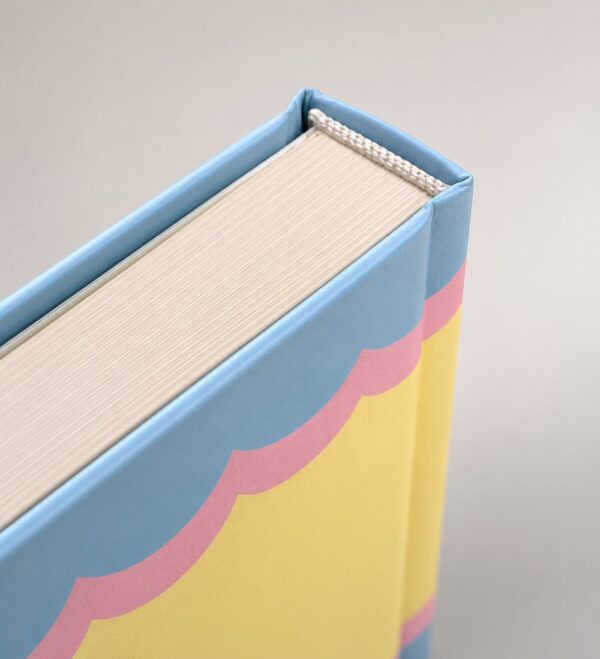
The signatures are sewn together with thread and then hung inside the cover. The strongest and most luxurious option, ideal for hardcovers and books that have to last. Lies open well and does not fall apart.
Adhesive binding (perfect binding)
The pages are trimmed at the spine and attached to the cover with strong PUR glue. Economical and fast, perfectly suitable for novels, manuals and business publications.
Saddle stitched (staples)
Two or three staples through the spine. Fast and cheap for thin publications up to around 68 pages, such as magazines, brochures and slim catalogues.
Wire-o (spiral binding)
A double metal spiral that lets the book lie completely flat. Perfect for cookbooks, workbooks and manuals.
Quick comparison
- Luxurious & strong: section sewn
- Economical & versatile: adhesive binding
- Thin & cheap: saddle stitched
Not sure which binding suits your page count? We will recommend the strongest and most economical option for your book.
Bindings and your choice of paper
The binding and the paper choice are connected. In a thick book on heavy paper a lot of tension builds up in the spine, which argues for a sewn binding. Lighter paper is more supple and works well with an adhesive binding.
Not sure which binding suits your page count and paper type? Have a look at our explanation of thread-sewn or adhesive binding as well, the two most chosen options for books.
How many pages suit which binding?
The number of pages often decides on its own which bindings remain. A saddle-stitched finish works up to around 68 pages; above that the signature gets too thick and the book gapes open. From about 24 pages a glued spine is possible, and only from about 50 pages is that spine wide enough to carry legible text. Section sewn pays off above all in thicker books that are opened frequently.
With a saddle-stitched booklet the number of pages also has to be divisible by four: every sheet yields four pages. If you end up at 30, it becomes 32 with two blank pages. Decide yourself where those fall, for example at the back, rather than leaving it to the layout.
Lying open and the inner margin
How flat a book lies open is directly connected to the binding. Section-sewn books fall open most beautifully, because the signatures are sewn to each other and not fixed to the spine. A glued book wants to close and loses a few millimetres in the gutter. For a cookbook or music book that has to stay open on the table, that is a decisive difference.
Set your inner margin accordingly. In a glued book of more than 200 pages you allow at least 20 mm on the spine side, otherwise you read the first letters into the fold. If a photo runs across the fold, choose section sewn; otherwise the middle of your image disappears. You can read more about that difference in our article on thread-sewn or adhesive binding.
Bindings and the impression they give
Besides practical considerations, the binding also determines how your book looks. A hardcover with a sewn spine radiates quality and feels like a properly published book, which suits a photo book, an anniversary edition or a dissertation. A wire-o binding looks practical and approachable, which works well for a workbook or manual.
The spine plays a part too: only with a glued or sewn binding can you place text on the spine, so that your book is recognisable when it stands on a shelf. With saddle stitching and wire-o that is not possible. If you want to know more about professional finishing standards, take a look at ISO.
Frequently asked questions about bindings
Which binding lies flattest open?
Wire-o lies completely flat and section sewn also lies open well. An adhesive binding tends to close, certainly in thinner books.
From how many pages is saddle stitching no longer possible?
Above around 68 pages saddle stitching becomes impractical. Choose a glued or sewn spine instead.
Which binding lasts longest?
A sewn binding is the most durable and the best choice for books that are kept for years.